
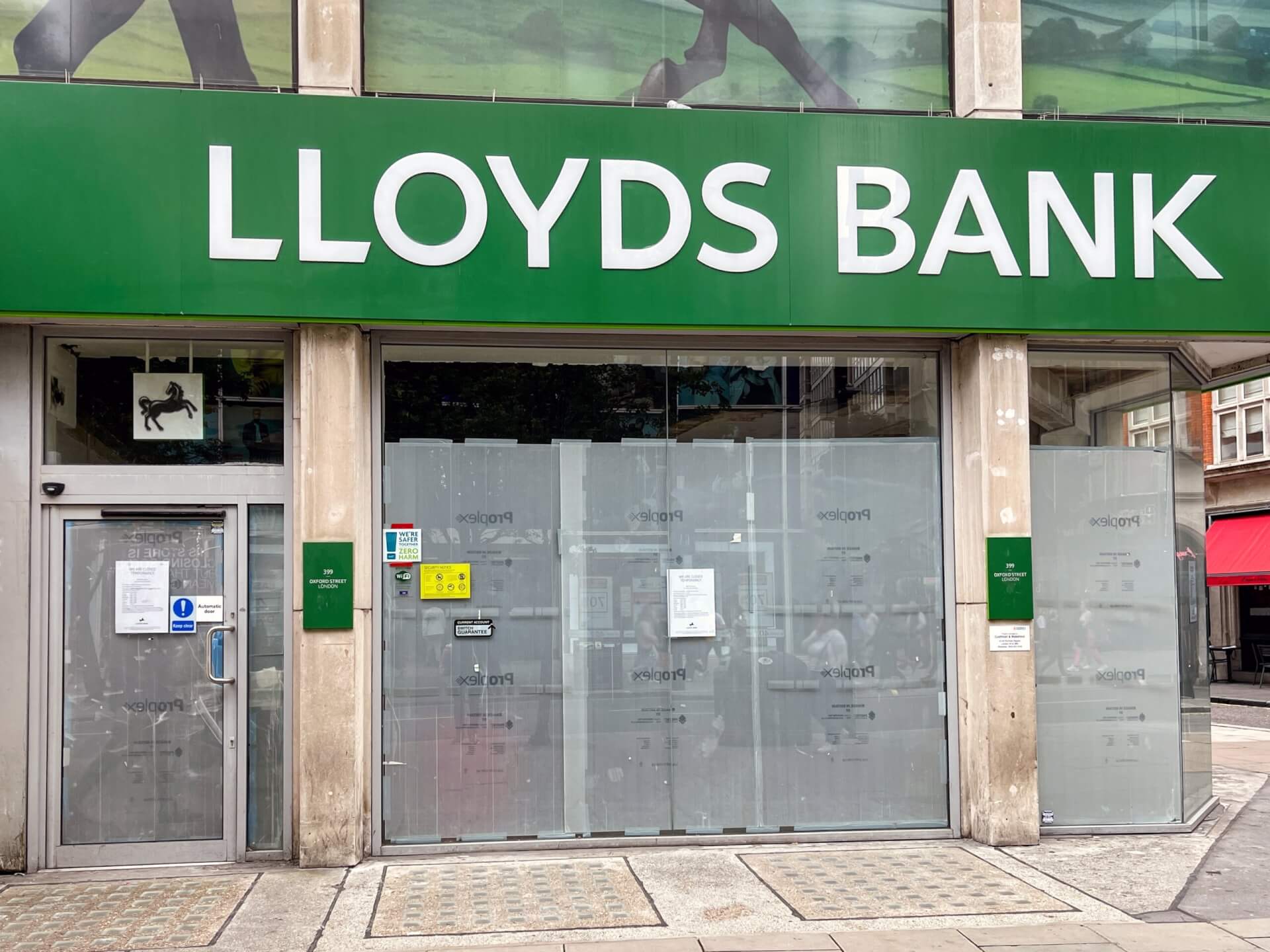
Last week, Lloyds Banking Group announced it was closing 18 Halifax branches and 22 Lloyds branches in England and Wales, over a three-month period beginning in April this year. The news followed announcements from HSBC, Natwest, Barclays and TSB that they would be closing more than 200 branches between them over the course of 2023.
All the major banking groups argue that the closures are justified because fewer customers are using physical branches as the move to digital banking continues to gather pace.
Few would dispute that as with public telephones before them, physical banks are becoming less and less relevant in a digital world – but what impact will the raft of newly announced closures have on the high street? Will the space be gobbled up quickly by other occupiers or like much of the vacated retail space, will it sit empty for years and create another headache for landlords?
Around 9,700 sq m (circa 105,000 sq ft) of bricks and mortar space could come back to the market following the closures announced by Halifax and Lloyds, according to data from Nimbus shared exclusively with BE News.
According to Nimbus data, the total square footage of the space vacated by Halifax is 4,502 sq m (circa 48,500 sq ft), with Lloyds looking to exit 5,248 sq m (circa 56,500 sq ft).
The good news for owners of the buildings vacated by the banks is there is a strong chance they will attract new tenants relatively quickly, according to retail and F&B agents.
Will Thomas, partner of KLM Real Estate, says: “Banks are generally easily accessible at the heart of town centres and well configured. They should therefore be suited to the increasing number of community uses that are seeking to grow – health and medical centres, hybrid working hubs, refill shops etc. This is part of the constant evolution of our high streets and town centres.”
He adds that the overhaul of change of use policies will also make life easier for landlords looking to find new occupiers to fill the space. “Recent changes to the planning regime are positive for reletting prospects as Class E permits a broader range of uses than the old ‘Class A1 and A2’ categories. Many within this new category will be very comfortable dealing with potentially hard, or historic frontages, challenges that may well have scared off A1 occupiers in the past,” says Thomas.
Simon Morris, managing partner of GCW expects further closures of bank branches by some of the large banking groups as the nature of banking evolves, meaning even more square footage could be vacated over the coming years. This presents both challenges and opportunities for potential new occupiers, he says. “Location as ever is key,” he adds. “Building style which varies between historic and listed to contemporary and functional is particularly influential creating both opportunity and restrictions.”
Thomas concurs on the latter point. “The presence of strong rooms within the branches is likely to be an ongoing issue for most,” he says. “They are expensive to remove and often unsuitable for most occupiers. This could present an opportunity for the fleet-of-foot and creative independent businesses to exploit.”
In addition to independent, local businesses, Morris thinks that could be a wide range of other takers for the best located space.
“Aside from occupation by conventional uses, retail uses including coffee and food and beverage and those with parking/outside space have seen conversions to children’s day nurseries, community centres and of course residential in its many forms,” he says. “There’s often an opportunity to make use of upper parts that have historically laid dormant.”
Whilst bank closures are often bitter blows to the communities that they serve, Morris thinks that reoccupation of vacated space should come sooner than it may have done historically due to the more flexible planning use class system highlighted by Thomas and the recently “rebased occupational costs particularly business rates”.
In short, landlords should be able to bank on these mothballed branches not sitting empty for too long.



If you like a lot of content in your newsletter, join our club!