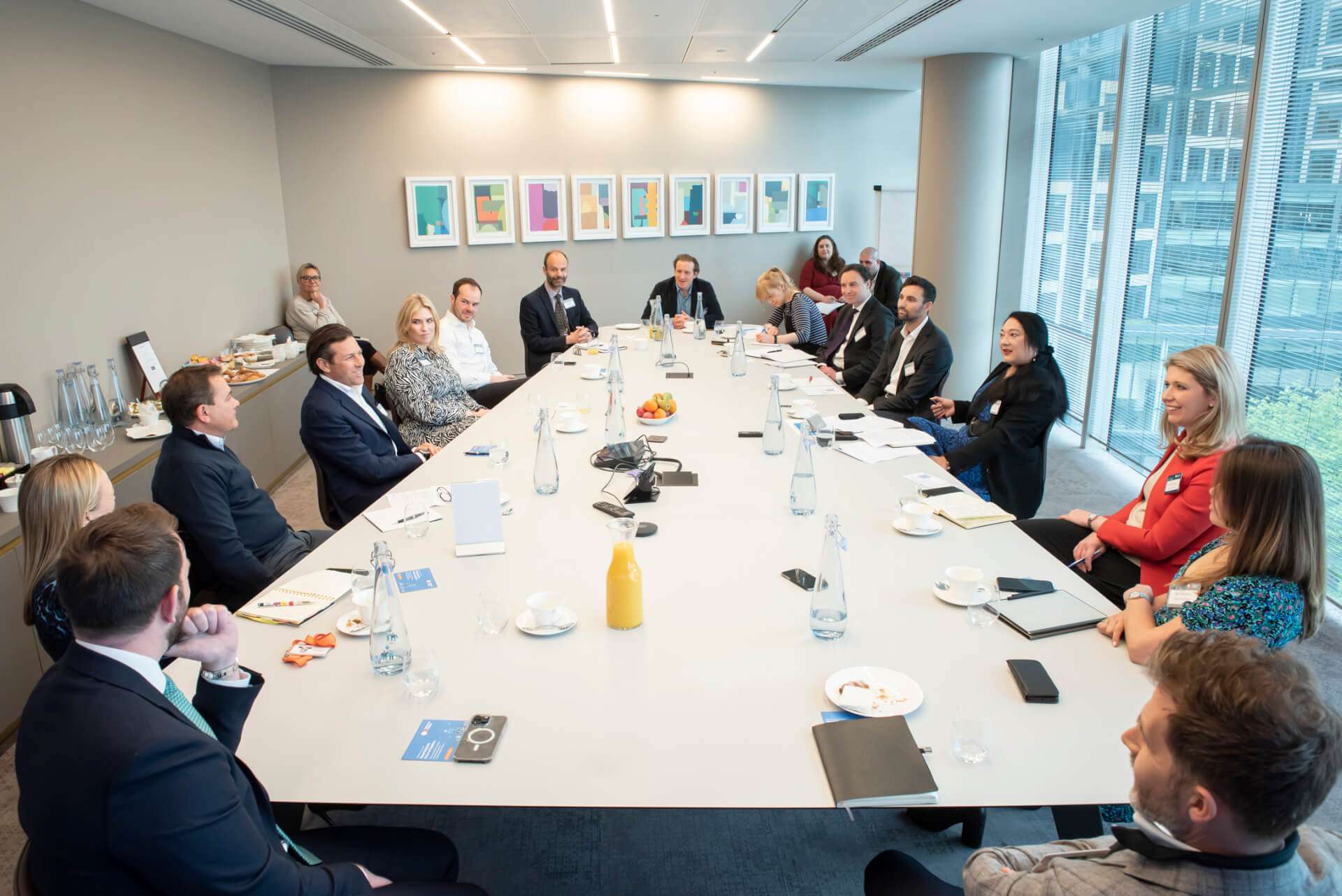
Some of the biggest names in industrial and logistics joined BE News editor-in-chief Liz Hamson last month for a roundtable breakfast debate on the evolution of the sector. Among the topics discussed were the transformation of community, technology, landlord and tenant relationships and energy.
Hosted by sponsor Osborne Clarke, we share the edited highlights of the wide-ranging debate on how the property market is tackling, adapting and rising to these challenges and opportunities.
Panellists:
- Leon Alvos – principal, Mirastar
- Mike Best – head of logistics, British Land
- Louise Cartwright – head of real estate, Osborne Clarke
- Nick Clayton – head of corporate finance, Warehouse REIT
- Ben Gomez-Baldwin – Greater London director, SEGRO
- Toby Green – director, head of London and South East industrial and logistics, Savills
- Paul Hanley – partner, Bridge Industrial
- Deborah Harvey – head of energy innovations, Osborne Clarke
- Nick Heath – head of development, LondonMetric
- Alex Hickman – asset management director, Kingston Space Property (GLI)
- Emma McPeake – co-head of logistics, Osborne Clarke
- Zoe Thomson – development director, Helios Real Estate
- Ian Wilkinson – head of the built environment sector, Osborne Clarke
A key finding of the Unpacking the Future of Logistics report published by Osborne Clarke* was around energy, and the desire to get off grid, but how do we go about doing that?
Harvey: While going off grid is a noble ambition, there is still a role for import electricity – renewables are an intermittent power source – and there is often also a need to export onsite generation to grid. So the objective is instead to reduce reliance on the grid. We recognise the real need for buildings to have the ability for self-generation: rooftop solar, possibly co-location with either ground-mounted solar or wind, with electricity being provided through a private wire.
In terms of how you go about that? There are numerous ways and there is no standard approach – we see a number of models. Some providers enter into a joint venture arrangement with a specialist renewables developer, others procure renewables on a self-development basis. We also see spaces, for example rooftops, being leased by the landlord to developers, or tenants, to facilitate renewables development.

Gomez-Baldwin: Green leases have come to the fore, and we have clauses asking about the reasonable endeavours of our customers to procure their energy through a green lease arrangement, which is essential to our net zero carbon ambitions by 2030. We are also looking at battery storage and doing it on a unit-by-unit basis.
On the battery point, our view at SEGRO is let’s focus on getting the solar done first, be more advanced and put our capital there. Being honest, most energy we generate from solar is being consumed during working hours so there would be none to store. Let’s not run before we can walk. Let’s do the solar, and battery will follow.
Thomson: We’re on site currently for a 78,000 sq m facility in Vienna Airport and we’ve found it easy dealing with the photovoltaic [PV] systems installed on the roofing and on the surrounding 28ha site. We can’t use [this land] for buildings so instead we’ve installed the PV systems, are selling it back to the grid and offering reduced rates to our pre-let tenants. We have found it a different experience to what it is Over that last three or four years, occupiers have increasingly wanted solar-enabled roofs so that they can retrofit photovoltaic [PV] panels for additional or replacement power generation and future-proof their needs. It does have a knock-on effect on build costs over and above inflation. Strong rental growth and low yield have maintained viability in recent years. We are still seeing solid rental growth but the current higher yields are challenging viability of development in some cases.in the UK.
Hickman: Exporting off the grid depends on how much money you get when selling it. Previously you could get more, but now you don’t so there’s very little incentive. Alternatively, look around your estate. Some users might find they don’t use much after a certain time, or at a certain time of the year. If they can export it and sell it to neighbours on the estate for a better rate than you get from the grid, but less than they would have to pay from the grid, everyone wins.
Heath: A constraint we have experienced, subject to where you are in the country, is being able to export to the grid. We are looking at batteries the other way around: that they can take the excess so we don’t get the constraints in the size of installation we can put on the roofs.
The frustration is that you can really play the system – something the network must think about: how you can take some of that capacity as opposed to those that have got in there first.

Hanley: That’s an important point. There’s more capacity in the grid than people realise, and the more noise we have around power and how scarce it is, the more people want to defend and keep. [I knew situations] where people would reserve three or four megawatts. We would go and see them after two years and they’d never be using more than one megawatt, but they don’t want to give up that three megawatts. If you multiply that with every user on the estate, you could have 10/12 megawatts never getting used. There’s no way to take it back unless someone volunteers. No one wants to let it go because they might never get it back again.
Green: Over that last three or four years, occupiers have increasingly wanted solar-enabled roofs so that they can retrofit PV panels for additional or replacement power generation and future-proof their needs. It does have a knock-on effect on build costs over and above inflation. Strong rental growth and low yield have maintained viability in recent years. We are still seeing solid rental growth but the current higher yields are challenging viability of development in some cases.
Alvos: We are currently looking at solar installations across the portfolio and aim to have these carried out within the next two to three years. Some installations will even start this year. However, we are finding that roof weight-bearing capacity varies and some units will require a more detailed review as lightweight solar solutions are currently less attractive due to high costs and lower power generation. Energy storage is also not usually cost effective, with technology in this space moving very fast, causing obsolescence risk.
Today the sector is more about collaboration, and there’s more technology and data being used, and the importance of that is one of the other key findings in the Osborne Clarke report. But where we are going on the data and technology front?
Cartwright: The report identifies that advancements in technology bring opportunities for landlords to supply additional services to tenants to generate additional revenue streams. The possibilities identified include areas such as mobility, robotics and EV and AI as a service. The provision of these services from landlords would mean a move away from the traditional landlord-tenant relationship and require a longer-term partnership approach between landlords and tenants.
The opportunity for landlords to invest in systems to harvest operational data from warehouses and to use it to identify and analyse trends is substantial, but leads to the question of who pays for this technology – the landlord or the tenant?
It can take several years to recoup the costs of installing such technology, which begs the question of whether longer lease terms will become more popular again to spread those costs, whether for the landlord or the tenant. This could be an interesting change, given the move in recent years towards much shorter lease terms in general.

Clayton: The cutting-edge technology you see in the sector requires a lot of investment, often from tenants, driving people down much more bespoke, purpose-built, built-to-suit-type property. This is different to the shorter-term, multi-let part of the market, where people aren’t necessarily applying massively cutting-edge technological solutions, at least into the physical aspects.
Take a step back a bit. We see warehouse logistics space as essential infrastructure for the economy. Therefore, within the fourth industrial revolution, the technology- and data-driven demand cycle permeates everything to do with the sector, and the sector is a by-product that will get dragged along with developments as they’ve been doing, and it will adapt to them.
We see changing demand patterns brought about by technical change, by the internet, as positive because it can adapt to supply chain changes.
Hanley: Data is a real monetisation opportunity. Visa makes more money from selling its data than it does from credit card fees. The reality is that people don’t know the value of it, or how to use it. There are numerous things operationally you could do with all the products within warehouses – people just don’t track it [the data]. But it needs input and consent within the lease.

Wilkinson: The real problem with data in the built environment is that we deal with it in silos, and we don’t share across those silos: landlords don’t speak to tenants about the data they are collecting, which is often the same bits of data. They don’t want to share it, citing lawyers, regulators, as being a barrier, which is a misunderstanding rather than a fact.
The opportunity will come if we can share data and be more efficient about it, which we need to be as the compliance regime ramps up.
Green: If you’ve got a distribution park, or a multi-let estate with single ownership, it’s hugely valuable to the landlord and the tenant to have the data on the power/utility usage. Occupiers often provide significant contingency for their power needs when planning their fitout/operations.
Collecting and sharing data should help the landlord and the tenant to collaborate to potentially reduce their standing charges and operating costs and provide for more efficient allocation of power, which is in tight supply across many locations. If you don’t do that, there’s going to be a blockage where certain sites won’t lease.
How is the sector perceived by the community, and is there an understanding about what industrial is, or the social impact it has, considering ‘social value’ has become a big buzzword over the last three or four years?
Wilkinson: We’re on a journey that started with the planning regime trying to align ourselves with employment land policies. It’s been influenced by a constrained labour market creating nice places for people to go and work, and the slightly different jobs we’re trying to promote. Not the low-paid, low-skilled, but the high-skill, the mixing of your head office and sales team with your distribution team.
There are longer-term relationships between the landlord and tenant, and we’re also dealing with more complex, usually larger-sized buildings. Whether you are a developer or a trader, you are in that site for a long time, then you must live alongside the community for a longer period than previously.
People are thinking about the wellbeing and the impact within the red line of their asset, and the interaction of that asset with the community around.
As we build in ever-constrained geographies, if you are going to get a consent, it’s got to absolutely work alongside the community. It’s got to be an active building, not passive, and beneficial to the community.
This hits a lot of ESG policies so could access cheaper finance and a wider pool of capital. It could mean the numbers you put in your building appraisal will be able to stick because you’ll be able to deliver quicker, because you’re not being challenged as much in the planning process.
There’s a whole range of benefits and I think we’re just starting to realise them, and it’s a good thing.

Gomez-Baldwin: [The reception to Responsible SEGRO has] been fantastic. I’m mentoring three schoolchildren, helping them with career development ideas, while we are using our contractor, Glencar, to go into schools to give talks, and provide apprenticeship and training opportunities, outside the planning obligation.
This is what we should be doing: providing job opportunities for the local environment. As an asset, as a building, it creates a lot of jobs and brings a lot to the community, even if it’s a bit misunderstood.
Best: We have the opportunity in some of our schemes, particularly Paddington Central, an office campus, where we can introduce logistics and plug it into the social side we are already doing there [British Land got planning for a 121,000 sq ft ultra-low-carbon logistics hub earlier this month]. That’s good from our perspective, and we want to be engaged in the community.
Being in central and mixed-use locations, it’s going to be critical to make sure these facilities work. It’s also more important now to occupiers, particularly with the labour shortage, as they’re focused on how to retain their staff. Providing an environment people want to work in is high up on their agenda to ensure they can successfully operate these buildings.
Where do we think the market is going in the next three to five years? What are the hopes, fears and expectations?
Hickman: Let’s mention town planners. I can’t see a great deal changing because currently, they say a deal, or a situation, is probably right when everyone leaves upset rather than one side wins. I can’t see any new political party wanting to change it a great deal. They are not going to put the power either in the Nimbys or the bulldozers, so they keep with the slow, almost impasse we have in lots of local authorities.
Is it a fear, worry? We are stuck with what we’ve got.
And what’s the implication? If the cost of money is expensive, or getting more expensive, you’ll be disappointed. Unless you’ve got adequate funds to cope with things taking longer, then you will be fine.

Alvos: My hope is that the occupational market will be strong and current ecommerce trends remain in place. Fear is that construction and interest rates will remain high. I expect that a larger number of retrofits and capex improvements will be required in future due to stricter regulatory and social pressures. Assets that do not meet the minimum regulatory standards may also become stranded as long-term investors move to avoid assets with higher and more intensive future capital requirements.
McPeake: We will always come back to the bread and butter: that we build and develop warehouses, lease them to occupiers, then we sell them and get funding. But we are increasingly looking at the asset as an investment. People are opening their buildings to the public, genuinely looking at data, but I think the conversation around energy, power, is going to occupy thoughts for a long time.
*From November 2022 to January 2023, Osborne Clarke experts, with developers, occupiers and researchers, worked alongside Meridian West and Brook Intelligence, on a mixed-method programme of research, consisting of desk research and in-depth interviews.
The research concentrated on the future of logistics, with a particular focus on three trends: technology and data; energy; and social impact. Click here for a copy of the report