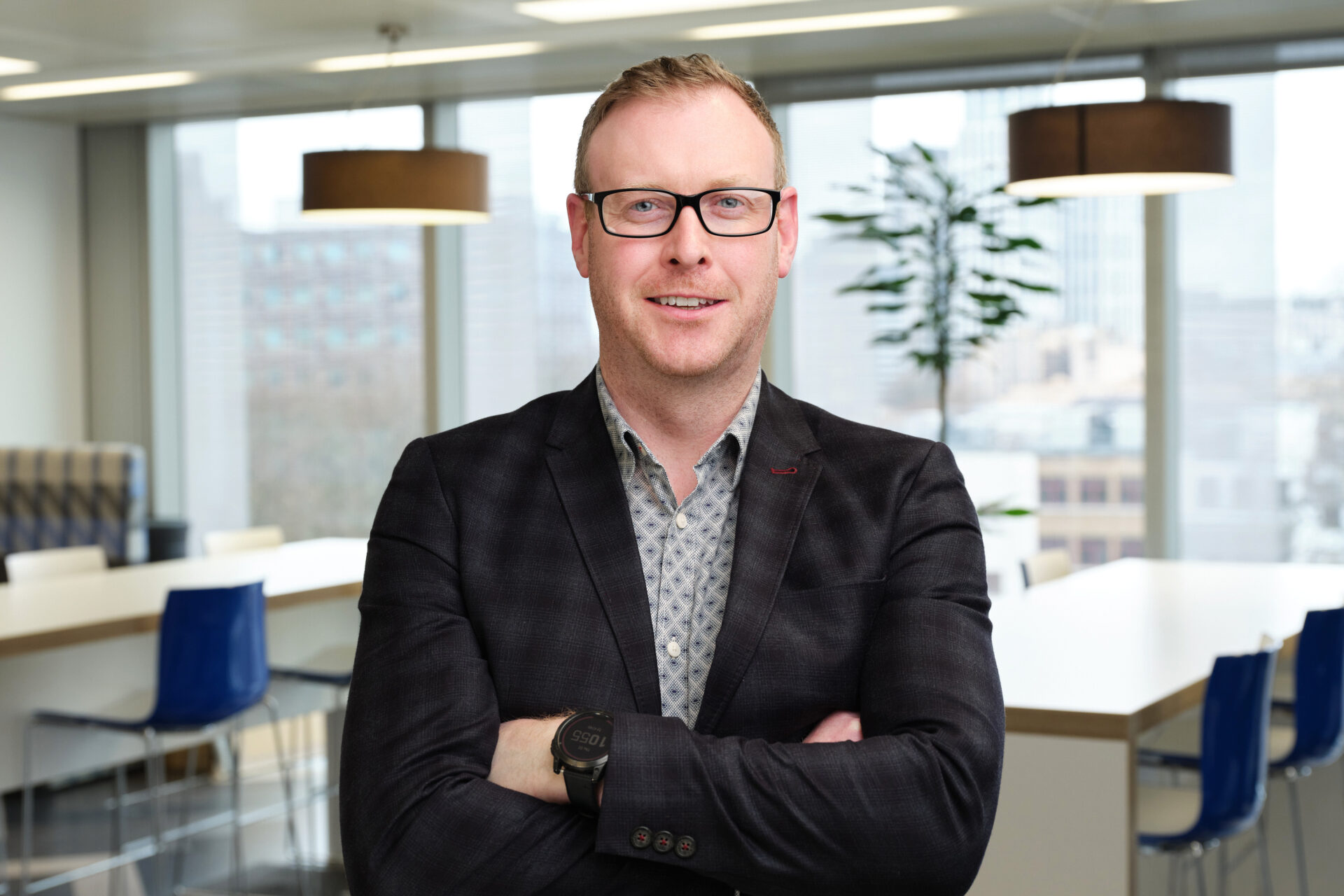
Name: Ruairí Dempsey
Job title: Electrical area business class lead, HDR
What I do: Since joining HDR, my day-to-day responsibilities have combined project delivery and business development. The first part is more technical, using my training as a chartered building services engineer to procure and manage projects. The second involves taking a strategic view about which sectors and projects we would like to pursue across HDR’s different locations, along with attending conferences and building tours, in addition to breakfasts, lunches and dinners to build strong client relationships. I have recently been promoted to a role that will allow me to work alongside and manage the Electrical Engineering Business Class across the UK and Ireland.
Besides my official role, I identify various industry awards to showcase our team’s skills and expertise. I am an executive sponsor of HDR’s employee network group for disabilities. I also chaired a local branch of a Dublin-based organisation, Comhaltas, which promotes Irish culture, and am currently chair of the British Council for Offices (BCO) Northern Ireland Regional Group. This role provides me a seat at the table for the Northern Chapter committee and I also act as a judge for different BCO awards, including the newly launched BCO Customer Experience Award. I am a trustee for a local community charity assisting with the development of a new education and community facility.
Why I got into the property industry: Completely by chance!
How I did it: While studying for my A Levels, I needed to secure a week’s work experience, so I asked my friend’s father, who ran a successful MEP consultancy business in the village I’m from in Northern Ireland. I completed the placement, liked it, and even got an award from my school as the best performing student on work experience.
My first proper job: After earning my degree in electrical and electronic engineering from Queen’s University in Belfast, and thinking about my future, I called the company where I’d completed my work experience and the boss agreed to interview me, following which I was offered my first proper job.
My first big break: I found the sector challenging at first and, after two years, faced a decision on whether to focus on music professionally or stick with engineering. I chose engineering, and from there completely fell in love with this profession as something I could see myself doing long-term. Much of this approach is thanks to key individuals along the way who opened up opportunities, supported me and taught me the work ethic, skillset and flexibility required to succeed in my field.
My inspiration(s): On a personal level, my parents and my wife and daughter have been incredible (even through the years when I was away from home five nights a week while commuting between Ireland and London), always championing me and allowing me to do what I needed to do to progress. My eight-year-old daughter is my best friend and inspires me to think creatively, and to never lose my child-like curiosity. In terms of professional inspiration, I’ve been lucky to have several great mentors and managers who led by example, as well as people whose stories, including succeeding despite obstacles, remain an inspiration to this day.
The biggest challenge I’ve encountered to date: I suffered a significant head injury at university and ended up badly concussed, the neurological effects of which lasted for a further eight years. Another major challenge was the global financial crisis, which hit just a few years into my career, so I needed to work extra diligently to keep my job including diversifying into other areas and even moving to the Middle East for a short time. Overall, I’d say the biggest challenge I’ve ever overcome is me! This industry can be intense, and it took a toll on my mental health at one point. I shifted my working patterns and, through constructive and objective self-reflection, took control of what I could. This changed everything.
My greatest achievement/proudest moment to date: Working as part of a multi-disciplinary team on the Titanic Museum in Belfast in 2012 was a career-defining moment. There were limitations on what could be achieved so I really enjoyed thinking laterally and coming up with solutions as part of the team. At HDR, where I’ve been for over a year now, I recently nominated several of our younger employees for awards, including the BCO NextGen Awards. Two of our people reached the finalist stage against stiff competition. This wasn’t my achievement, it was theirs; however, what a stand-out proud moment for me to see the future generation of engineers receive this recognition.
The biggest misconception people have about the property industry: Working predominantly on the development and construction side of the property industry as I do, there was traditionally a perception that this sector has a low skill entry level. Whilst this may still be the case in a limited number of roles, entry into, and success within the property industry, generally requires a high level of expertise and training both from a design and construction perspective.
My biggest bugbear about the industry/the one thing I would change about the industry: My big bugbear is the distillation of complex problems into checkbox exercises, where people assume they do not have to think beyond just meeting a certain set of criteria. As an industry, we need to become better at prompting decision-makers to think at a deeper level about wider impact. For example, rather than simply ticking off a generic accreditation list, really considering who will be using that building, with a real focus on tenants and a more people-centric approach, and naturally looking ahead to how future generations will work.
Why I’m so passionate about DE&I: I care about creating an equitable future for two reasons. First, because I have a daughter, and I do not want gender to be a barrier for her in life. Second, if all ideas come from the same people, that will be a very limiting future for the next generation. It is impossible to deliver successful and lasting projects without representing everyone who will be using these buildings. The larger the mix of people around the table, the more we can challenge assumptions, bring fresh perspectives, spark brainstorming and innovation. A thriving property industry depends on cultural inclusivity.
Where I’d like to be in five years’ time career-wise: I hope to progress within HDR and, the more people I have responsibility for, the more people I can work with to help create a more progressive culture. I would like to continue helping the company champion and mentor the next generation of employees. Aside from that, as I am based in Ireland where HDR has a presence, I would love to see how we can further grow the brand in Ireland by harnessing our own USP.
Who I’d invite, living or dead, to a dinner party: Nicola Tesla and Alan Turing were incredible minds. Definitely Billie Holiday, an amazing talent who overcame adversity to shine; Helen Sharman, the first British astronaut in space; and also Douglas Adams, as the ‘Hitchhiker’s Guide to the Galaxy’ has always been one of my favourite books. On the other side would be Nobel prize winning Northern Irish astrophysicist Jocelyn Bell Burnell, Swiss astronomer Fritz Zwicky, and Cecilia Payne-Gaposchkin, who made some of the greatest discoveries of the early 20th century. They would make for exciting conversation, as would mathematician Srinivasa Ramanujan.
What I do in my downtime: Family time is very important to me. I also sit on multiple committees and am a Trustee of a local charity, building a facility for community use. When I’m not doing all that, I love music and play several instruments. I’m in the process of writing and recording a five-track album and was honoured to be asked to organise the band for a recent HDR conference in the US.
The job I’d be doing if I was not doing this: I feel like I’m in the right place, however, if I had to choose, it would probably be either music or embarking on PhDs in neuroscience and astrophysics.
My advice for someone just starting out: I think the most important things you can do for yourself is focus on self-development, self-reflection, asking the right questions, being able to accept when you’re wrong and always remaining willing to learn and change.
My motto/mantra: John Archibald Wheeler (1911-2008) said, “We live on an island of knowledge surrounded by a sea of ignorance. As the island of knowledge grows, so does the shore of our ignorance.”