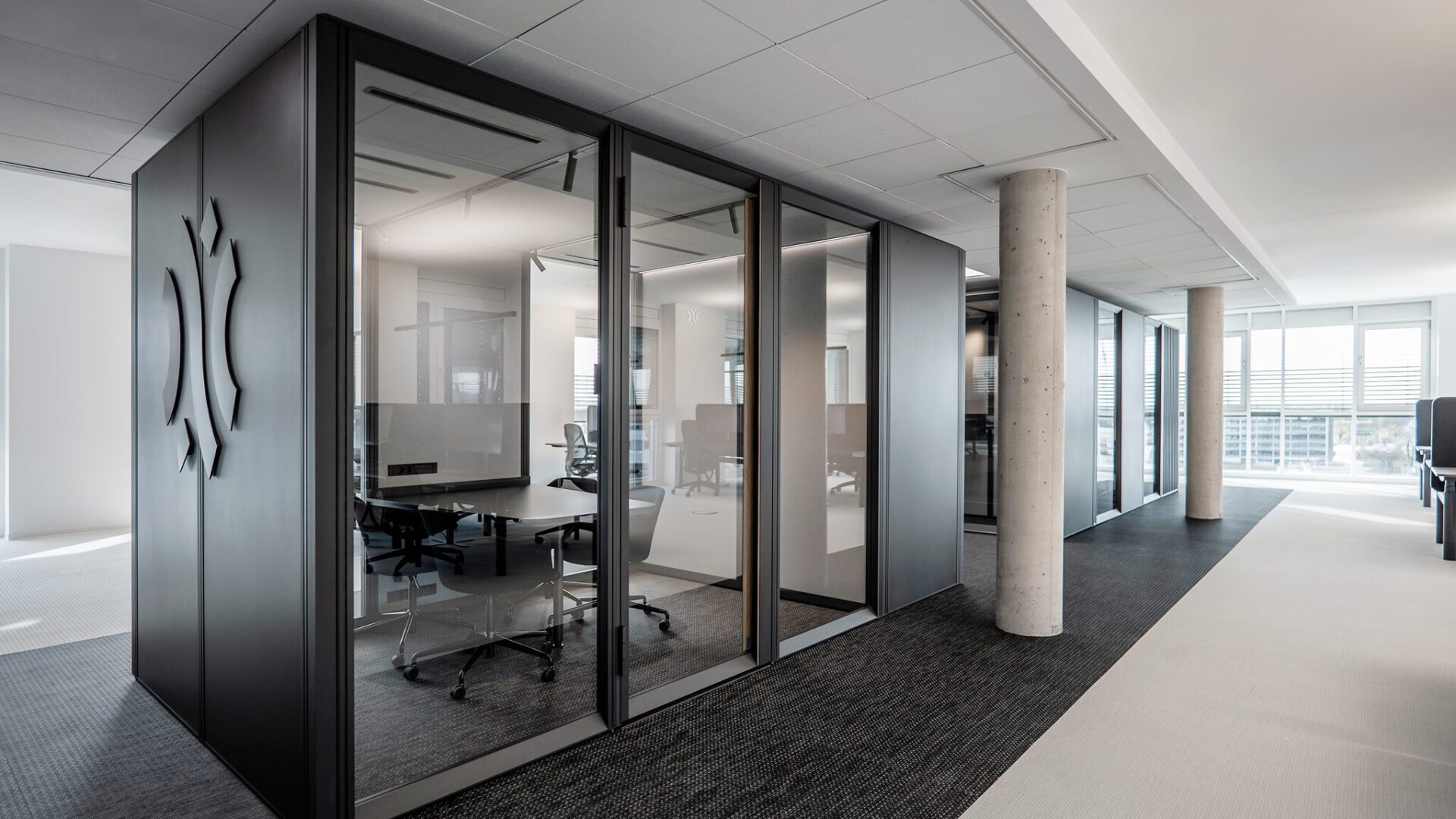
A new independent study has found that modular meeting rooms can deliver substantial cost and carbon savings over a typical office lifecycle, challenging the long-standing reliance on traditional, site-built meeting room construction.
Commissioned by Mute and undertaken by cost consultancy EthosEQ, the research is the first to compare traditional plasterboard and glazed meeting rooms with modular room-in-room systems across a 10-year operational period. The analysis considered cost, programme impact, adaptability and embodied carbon.
The study examined meeting rooms across 27 cities in Europe, the Americas and Asia-Pacific, reflecting a broad range of construction and labour cost conditions. Importantly, it also modelled the impact of reconfiguration during a lease term a common occurrence in modern workplaces, but one that is rarely factored into initial fit-out decisions.
Reuse emerges as the defining advantage
According to the report’s author, Colin Wood, the ability to reuse modular rooms fundamentally alters their financial and environmental performance. “Traditional meeting rooms are effectively single-use assets,” he said. “Once demolished, both their capital value and embodied carbon are lost. Modular rooms retain both through multiple cycles of use, which dramatically improves whole-life cost and carbon outcomes.”
Using market data published by JLL, the study estimates that if modular meeting rooms replaced traditional construction across the occupier market, total savings could exceed €1bn across EMEA and €1.5bn in the Americas over a standard lease term.
Whole-life cost outperforms capex
While modular solutions are often perceived as a higher upfront investment, the study found that this assumption does not hold when measured against real-world use. On average, modular meeting rooms were shown to be around 10% cheaper on day one, with savings rising to 60% in high-cost cities such as London, Paris and New York.
Once change is introduced, the cost differential increases significantly:
- Minor layout changes deliver average savings of 41% across all analysed markets
- Major reconfigurations push savings beyond 90%, reaching 150% in premium locations
- End-of-lease reinstatement costs for traditional meeting rooms are more than three times higher than modular alternatives
The report highlights that meeting rooms are often treated as permanent elements within buildings that are otherwise expected to accommodate frequent change – creating unnecessary cost, waste and operational disruption.
Implications for building owners and operators
For estates and facilities teams, the findings point to a growing disconnect between static fit-out approaches and the realities of shorter leases, hybrid working and portfolio churn.
“The decision between traditional and modular construction should be viewed as a strategic one,” said Szymon Rychlik, CEO of Mute. “When whole-life cost and embodied carbon are considered, adaptable room systems can significantly reduce financial risk and environmental impact across global estates.”
Industry response
The findings were discussed at a panel event (pictured below) hosted by Mute in Clerkenwell, chaired by David Taylor, editor of New London Architecture Quarterly. Panel members included sustainability, design and delivery specialists from BDG architecture + design and Wates Fit Out.

The panel agreed that while modular meeting rooms are not suitable for every scenario, they are increasingly effective when deployed as part of a hybrid strategy combining permanent construction for bespoke spaces with modular solutions where adaptability, speed and circularity are priorities.
Practical constraints were also discussed, with panellists noting that successful deployment depends on early coordination with building services, particularly sprinkler systems and air distribution strategies.
Supporting lower-carbon fit-out strategies
From a sustainability perspective, the study concludes that modular meeting rooms support circular construction principles, reducing demolition waste and retaining embodied carbon across multiple projects.
As regulatory and corporate pressure increases to reduce whole-life carbon in buildings, the report suggests that adaptable interior systems may play a growing role in helping owners and occupiers meet both financial and environmental performance targets.
This is a sponsored post