

Canary Wharf is slowly morphing from somewhere to work to somewhere to live. Noella Pio Kivlehan takes a look around its new luxury penthouses at One Park Drive
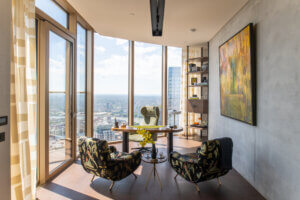
From the balcony of the 57th floor duplex penthouse at One Park Drive (pictured left), Wood Wharf, you can see all of London, the blanket of bright lights and buildings extending far into the distance.
The breath-taking view will set its eventual owner back nearly £4m to enjoy. Launched last month, the duplex is one of seven penthouses ranging from 1,637-3,904 sq ft located in the distinctive cylindrical, white tower of One Park Drive.
Tucked on a corner facing South Dock, the 58-storey centre piece building, which boasts 477 apartments alongside the penthouses, is designed by Herzog & de Meuron, the Swiss architects behind the Tate Modern and the ‘Bird’s Nest’ Olympic stadium in Beijing, with interiors furnished by Tom Dixon’s Design Research Studio.
The tower represents the top end of the residential offer at Wood Wharf, which ranges from affordable to BTR and private ownership. It is testament to how far this new pocket of the Canary Wharf estate has come since building started seven years ago on the former brownfield site. Thanks to Wood Wharf, the whole estate is morphing from a place to work into a place to live. The transformation has been a long time coming, but that is no surprise given the size of the estate.
“Creating a new piece of city is a challenge,” says Sophie Rosier, director in the Savills residential development consultancy team. “Since the 1980s, Canary Wharf has been an authentic financial district, and highly successful.
“If, as times change, it now needs to do more, be more, then a strategic approach in introducing new uses will be key. Canary Wharf Group are doing this in Wood Wharf, and across the estate. Many of London’s biggest residential players have sites there. The evolution has started.”
Now, thanks to the changing times Rosier alludes to, that evolution is likely to gain momentum and could culminate in a very different Canary Wharf to what was originally envisaged.
The London Docklands Development Corporation was created in 1981 to regenerate parts of east London after the port finally closed in 1980. With substantial government backing, the Isle of Dogs was granted Urban Enterprise Zone status.
The plan was to turn Canary Wharf into an office location that, with the City, would enable London to better compete on the global financial stage. The first building was One Canada Tower, which opened in 1991, and more followed, drawing the big banks to the location.
Residential was conspicuous by its absence. “It had 12m sq ft of office space, 120,000 office workers, almost 1m sq ft of shops, 300 bars and restaurants, but not a single residential unit on the estate itself,” says Brian De’ath, managing director of residential sales, Canary Wharf Group.
That changed in 2012, when CWG became sole leaseholders of the 23-acre Wood Wharf, which was swiftly earmarked for a new neighbourhood. Plans were submitted to develop 3,600 homes, offices, retail, hotel, leisure facilities, a new primary school and a doctors’ surgery. In December 2014, the Allies & Morrison masterplan was given the green light by then London Mayor, Boris Johnson.
While CWG was set on creating a new residential area, the existing offer acted as a draw for potential buyers.
“Sometimes in our position of selling residential you find yourself having to sell the dream in advance of anything having been constructed,” says De’ath. “But I could tie that dream back to something that was here. We would walk people around the estate, show them everything, and then stand looking across at Wood Wharf and say, ‘that is where your new home is going to be’. It gave people an incredible amount of confidence in us as a developer.”
Today, 1,000 people have taken-up residence, with 2,368 apartments completed comprising:
- 912 for sale apartments – 80% of which have been sold
- 1,137 apartments to rent by Vertus
- 319 intermediate and affordable rent apartments
De’ath says CWG worked ‘hand in glove’ with the local authority Tower Hamlets to make sure it provided the 25% affordable housing required that are in Harbour Square, the first completed on the development. “You have social tenants, affordable rent tenants, tenants renting privately through us, and then people who have bought the apartments for their own use,” says De’ath.
He is at pains to stress that “[Wood Wharf is] not just somewhere for rich people; it’s much more integrated into the borough than that”.
De’ath concedes that the current financial situation has made for ‘incredibly challenging times’. However, while it is still too early to see what impact rising interest rates and the cost of living crisis will have, De’ath notes: “Everyone currently moving in is for their own use. These are owner/occupiers purchasing apartments for them to utilise for themselves.
“It’s a change away from sales that would have been more investor-led, historically. Now we’re selling to people, and it will be their home for 10 to 15 years. They want to be able to grow into it.”
Outside Wood Wharf, CWG owns the five-acre North Quay site next to the new Elizabeth Line station.
There is currently planning for 2m sq ft of development, which could include residential. “We’ll be able to put a variety of buildings there,” says De’ath. “It absolutely allows for us to put residential there.”
The first building underway is a joint venture with Kadans Science Partner to develop a 750,000 sq ft GIA life science-focused wet lab. The 22-storey building will be ready in 2026 and is part of CWG’s goal to diversify the uses on the Canary Wharf estate.
“Diversification is essential to get that cross pollination between the different groups,” says De’ath. “When people say [Canary Wharf] is banking and finance, that makes up 45% of the tenants, 55% is telecoms, tech and there’s 1m sq ft of shopping, which people don’t understand because it’s not immediately visible being underground.”
By 2028, De’ath hopes Wood Wharf will have become firmly embedded in the estate.
“The greatest compliment paid to any area is that it feels established and has a real sense of place. In five years’ time I’d love someone to walk around and say: ‘This feels fantastic. How long has it been here? 20, 30, 40 years?’
“And for me to say: ‘No, the first residents only moved in 6/7 years ago’. That would be success.”
CANARY WHARF: THE BEGINNINGS
Architecture firm SOM – Skidmore, Owings & Merrill – drafted the original masterplan for Canary Wharf. Kent Jackson, design partner, London, explains its rationale, and how it influenced surrounding areas.
“If you take Canary Wharf as one of the monumental moments of the United Kingdom securing its place in Europe, and if it hadn’t secured it, we would be having a different conversation [about the original masterplan] than we are today.
“The CW emphasis was unlike anything we had ever done. In any other situation with large masterplans, we would have absolutely incorporated a much more mixed-use approach to development. But it was essential to bring the big banks to this location. This was the one area where you could get the large floorplates, the height and density, and the government was giving incentives for people to be in this location. It meant that first phase of Canary Wharf was never going to be anything more than commercial, led by these large financial institutions coming there.
“All things said, Canary Wharf has done an excellent job bringing in retail and residential. We were working with a lot of developers on Canary Wharf – Ballymore and others – to build up a lot of the residential you see in the area. We also worked on Arrowhead Quay and Mill Harbour and built thousands of residential units in the Isle of Dogs area that helped towards that growth and made it a single dimensioned masterplan of this financial empire, which ended up being called Canary Wharf.
“Everyone seems to have had the benefit, and this couldn’t have happened without a strong government push and the right development and design teams bringing that forward to allow it to fall in place. Canary Wharf didn’t happen by accident: there was a lot of risk, and people didn’t know the success Canary Wharf would have. But today they can see it.”



The demise of the REITs