

Many talk the talk when it comes to sustainability. Few walk the walk. Fewer still set the pace, as James Fry, founder of Beyond Apartments has. Since relaunching his sustainable aparthotel and serviced apartments business in 2021, Fry has been on a mission to “force change”, in his words, in the nascent arena of “sustainable wellness”.
Until recently, there wasn’t much by way of proof of concept. Prior to October, Beyond Apartments had just one location, which opened in 2021, on Great Portland Street in Fitzrovia, boasting 15 beds in eight apartments across three Georgian townhouses.
That is about to change. Beyond Apartments will soon open a mix of one- and two-bed, new-build apartments near Regent’s Park and a mix of one- , two- and three-bed refurbished apartments in the West End.
It will also venture outside the capital for the first time. Planning consent has just been achieved on a site in the Roman Quarter in York, where the business will operate an 88-bed aparthotel and 153 BTR apartments. A 17-bed aparthotel in Harrogate is in the pipeline and the operator has also been selected for a 50 bed site in the centre of Edinburgh.
It is little wonder that big hotel chains are beating a path to Fry’s door to seek his advice. However, at the moment, he is happy to forge his own path, as he told BE News when we caught up with him recently.
How would you describe yourself, as a hospitality or a sustainability company?
We are a sustainable company that happens to offer hospitality solutions.
What sparked your interest in sustainability?
I used to work for The Raven Property Group with a guy called Anton Bilton who taught me about the value of meaningful brands. We were developing a site in Switzerland, and I quickly realised that there were no strong brands in the serviced apartment sector. I went on to start Base Aparthotels based around three key pillars of sustainability, design and technology.
Are you surprised so few have followed suit?
There was absolutely no doubt in my mind that everyone is going to be doing this going forward, as governments will bring in more and more legislation, corporate clients will demand it from their suppliers and individuals will expect it from their brand they choose to spend their money on. It makes business sense, and it makes sense for the world around us. And I’ve watched flabbergasted as literally no one in the hospitality space took that up and really ran with it outside the luxury space.
What is your mission?
To create accommodation solutions in every major population centre in the UK that offer guests the opportunity to stay in zero carbon, zero waste, zero chemical, healthier spaces that are better for the health of our staff and the communities they serve.
Is it easier for a small business to innovate?
Yes. The analogy I use is the early days of the internet. You had Lycos, Yahoo and AOL. Big companies like Microsoft and IBM couldn’t adapt quickly enough and did not know what to do. It’s the same for Hilton, Marriott and InterContinental. They are all scratching their heads, asking: “What the hell do we do about this? Where do we go?” This is partly because they don’t own their hotels and it is much more difficult to do from the top down, than it is from the bottom-up. There’s a great opportunity for young, innovative, brave brands to go out there and make a mark.
How did Beyond Apartments come about?
Following on from my experience of founding, operating and exiting from Base Aparthotels, I wanted to create a meaningful business around my passion for offering low impact and healthier spaces for guests to stay and staff to work. I also realised that I had the practical experience alongside seeing the impact of our actions, that very few others had and that this experience was something I could grow a business around.
When did the brand launch?
I come-up with idea in 2020 and launched in 2021 with my JV partner Vengrove. We opened our first serviced apartment site in July 2021 in central London and secured our first aparthotel project in September 2021 in York.
How confident are you that you will get the traction you need?
We know that we’re in a good space that is only going in one direction. Nothing is certain in life, apart from one thing: sustainability is going to get more and more important for every business and individual and affect everything we do. Owners, developers and investors are slowly waking-up to the economic opportunity that this presents with the growing potential for lower cost of debt, lower exit yields and higher ADR’s.
What about awareness across the wider industry?
There are a lot of real estate people who are doing the minimum now and are going to get massively found out. You have stop thinking about what do I need to do now and look at the legislation that is going to force and demand drivers that are going force you to change in the future. Operators and owners are doing a disservice to their shareholders by not taking action now and future proofing themselves. As they will have to pay more later down the line.
How does the joint venture with Vengrove work?
Vengrove have identified the opportunity to work with operational experts to roll-out a PropCo/OpCo strategy. They provide strategic, development, real estate and balance sheet support. They are the perfect partner – as they give me the freedom to grow the brand and operational platform, while they concentrate on the development and funding of our roll-out.
What is your key priority?
Not compromising. We are building Beyond from the ground-up and are always looking for new solutions to provide a better guest experience that also happens to be low impact. We could have secured many more projects to date, if we compromised on our mission, but we also know that if we do it right from the start, we will create a brand that people don’t just like…but, love.
You currently have just one site, in Fitzrovia. When can we expect to see more Beyonds?
We are working on a number of serviced apartment sites in central London. In addition we’ve now secured sites in York for a 88-bed aparthotel and in Harrogate for a 17-bed aparthotel. The York scheme will use 100% electric energy, as well as air source heat pumps and solar power. We will monitor, measure and manage energy usage and will be 100% one-time plastic free, low waste and use zero chemicals. We will be leasing the aparthotel and also managing the 153 BTR units. In addition, we have secured a 50-bed aparthotel site in Edinburgh and are working on projects in Glasgow, Manchester and London.
What are your growth aspirations?
In five years’ time, when we hopefully have up to 15-20 sites open or in development, we’re going to be one of the biggest operators, if not the biggest ESG hospitality brand in the UK. That gives us opportunities to look at applying the brand in different areas as well, such as BTR.
Why BTR?
Hospitality providers are well placed to expand into BTR as people want hospitality solutions from the place they rent alongside the flexibility that BTR offers them. People have less job certainty and also want the flexibility to move from one place to another and BTR offers that. In addition, we are targeting the growing minority of people whose values, opinions and beliefs align with ours and will want to find low impact solutions … that also happen to be healthier spaces for them to live.
How do you pitch sustainable wellness to people?
If you say to people “Do you want to stay in a place that is carbon neutral?” they say “What’s in it for me?” If you say “Do you want to stay in a place that is low toxicity, where you’re going to sleep better, you’re going to wake up more refreshed and it’s healthier for you and family?” they say “Great, I get it and it is also great you’re carbon neutral etc.”
Do you think people get the climate agenda?
I think a lot of people think climate change just means the temperature is going to go up by 1.5-2.5 degrees. That, unfortunately, is wrong. It is all about the ends of the bell curve. We are going to experience more extreme cold and more extreme heat and that’s the worst thing that can possibly happen, because our infrastructure is not made for extremes, especially not in this country. In addition, it is going to cause the huge migration of people from areas where they can no longer survive and we are going to see seas of people wanting to come somewhere like Europe or the US and this is going to cause increasing international tension and strains on supply chains. Unfortunately, for the majority of people, everything is still dictated by their own personal circumstances and their day-to-day life. However, every part of our life will be effected in the future, so we need to do as much as we can now.
What about your customers? Do they get it?
We are targeting the growing minority of businesses and individuals who are looking for solutions that align with their values. We have to offer a great product and service but, more and more we are being approached by large companies and agents who are looking for solutions like Beyond. We know that anywhere we put a Beyond there will be a handful of companies and individuals who ‘get-it’ and will not stay anywhere else. These people tend to hang-out with people who share their values and they will tell them about their experience.
The pandemic also focused people’s minds on the need for cleaner air, didn’t it?
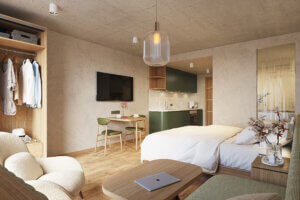
Yes, a big part of our wellness aspect is the air and environment. What we realised is that hotels are very toxic environments and that’s mainly because rooms have to be cleaned quickly. The only way of doing that effectively is by using heavy chemicals and by washing linen using strong chemicals. We filter the air, have no VOC’s in our paints and no toxic substances in our furniture. We have plant-lined pots and pans and zero chemicals in everything from our guest washing powder, dishwasher tablet and shampoos, etc.
So, what do you use instead to clean with?
We use a water and salt-based solution that has been ionised to create a liquid that kills 99.9% of bacteria, much like Dettol says it does. And you can drink it, so I get a “wow” in meetings when I take the cleaning liquid and I drink it. We use it on everything.
Doesn’t it cost more to be green?
Historically, there’s always been a green premium. However, there have been huge changes over the last few years in not only regulation but also suppliers. Most councils now make a BREEAM rating of Excellent part of the planning requirement – which means it does not cost more than you have to build to, compared to a few years ago. In addition, if people take five minutes to look for lower impact solutions, they will find them, they will not be household names, so they have to step outside their comfort zone. It is really important there is both a supply of solutions but, also a demand. The hospitality industry is a big consumer and by operators changing their purchasing decisions, they accelerate the supply of lower impact solutions.
What do your serviced apartments and aparthotels cost to stay in?
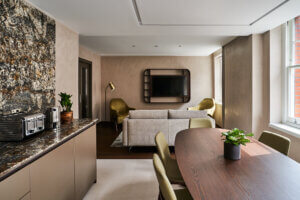
We’re in the four star-plus category. We’re not looking to compete on price; we’re looking to compete on value. So, with the service apartment offer, you can get 100/sq m for, let’s say, £500 a night, whereas you’d be lucky to get a very average hotel room for £250-£300 and that’s just 20/sq m. If you’ve got three kids, you need three rooms. That’s £750 and you do not have a kitchen or table and living area to spend time in together.
How long do people typically stay?
If it’s an aparthotel, they can stay anything from one night to one year. If it’s a serviced apartment, the average is a month at a time, but some stay for two months, some for three.
You didn’t develop your existing site. Will you look to develop your own sites in the future?
We employ an operational strategy. The idea is to manage sites through hotel management agreements (HMAs) and potentially through leases with developers who’ve got sites. That gives us traction more quickly.
What revenue are you targeting?
With serviced apartments in central London, we’re looking to get up to £5m in turnover in the next couple of years. We want to create a nice small business that showcases us in central London prime locations. We also want to roll out our aparthotel strategy across the UK to primary markets that have the corporate and leisure demand to 15-20 sites with a target of £50m+ of revenue.
How many units do you hope to have in the next five years?
We are looking for anything from 100 to 200 serviced apartments in London. In terms of aparthotels, we’re looking to have open and in the pipeline around 2,000 units. Often, we target around about 80 to 150 rooms per site, so let’s say that’s 15-20 sites. Then BTR is again 2,000-plus units, which will again be national.
How big do you think your brand could be?
We want to get to £250m-plus of real estate and an operational business that is worth £50m-plus. We strongly believe that there will be an inflection point when we will start to grow.
When do you think that inflection point might be?
When we open our first aparthotel, that will be crucial. I see serviced apartments as a stepping stone to aparthotels and aparthotels as a stepping stone to BTR and other areas.
Will you look for additional partners to help drive growth?
We are not searching for people right now, because we have a great set-up here with the capability and funds to do an operational rollout. However, a definite strategy is to partner with an investment firm or family office to roll out a strategy across the UK where we can develop sites that are then owned and operated by a mixed entity.
What’s your guiding ethos?
(Airbnb founder) Brian Chesky says: “Great brands create something 100 people love rather than something a million people sort of like.” That’s what we want to do.
How strong do you expect demand to be?
Governments are going to legislate it, corporates are going to demand it and the individual is going to expect it. If you don’t do this, you’re going to be forced to.
How easy is it to get your hands on suitable sites?
It has been tough to get stock. A lot of people have come back into the market quite aggressively to pick up serviced apartments in central London and there are not many aparthotels projects … but, that is changing.
What is your ultimate aspiration for the business?
The ultimate accolade would be if in five years’ time, someone says to another business: “You are doing that, so you are going to be like Beyond.”
What’s your mantra?
I love “Deeds, not words” from Emily Pankhurst. Unfortunately, it is 99% words at the moment. There’s very little action.
What are your thoughts about the short-term future?
The biggest problem in real estate is uncertainty. It’s a little bit scary and uncertain at the moment, but this also presents opportunity. But, the future is bright for Beyond and we are looking forward to being able to offer more guests our unique accommodation solutions.



If you like a lot of content in your newsletter, join our club!