
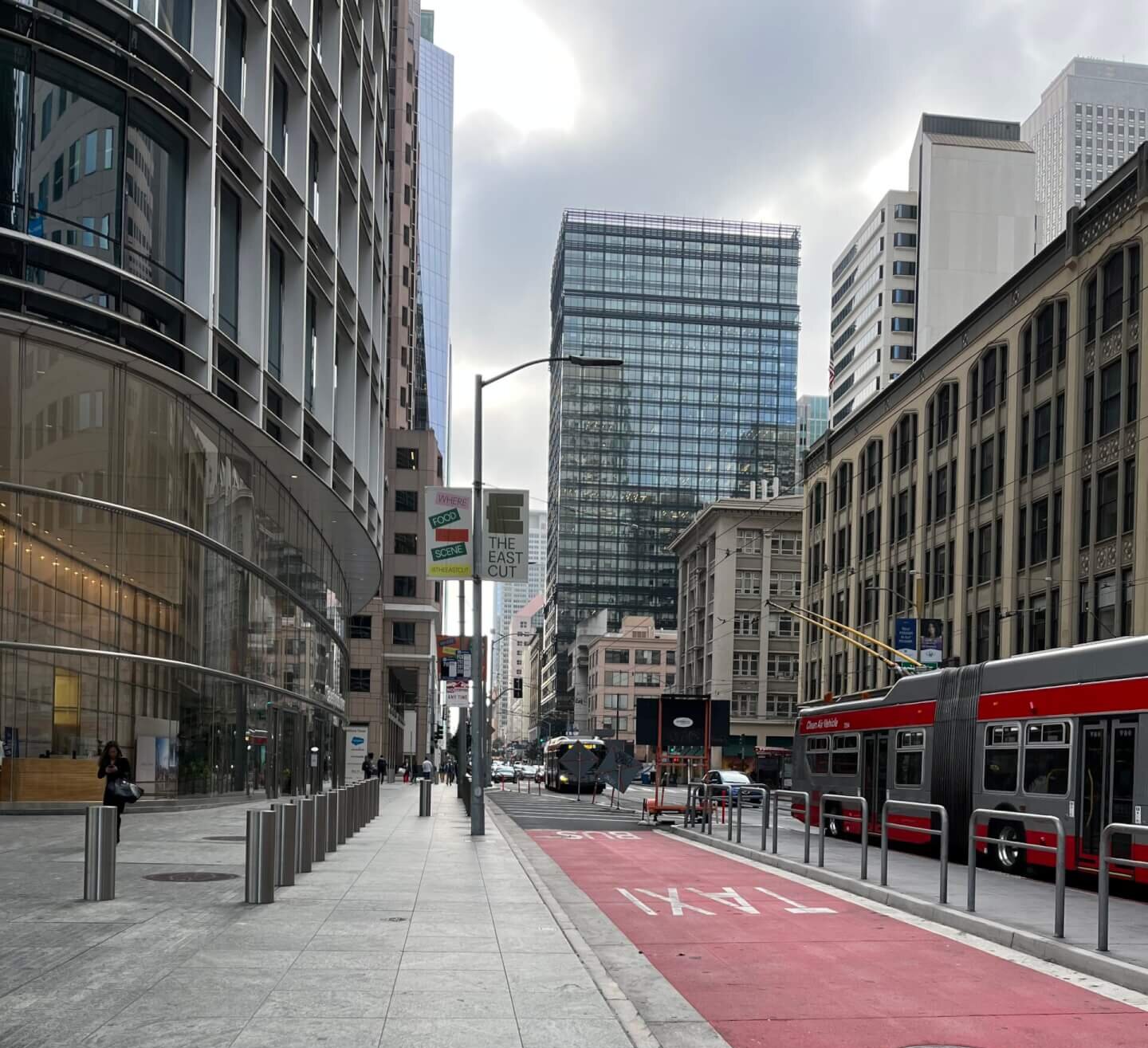
The ‘ghost office’ phenomenon is only one part of the story of San Francisco’s shocking decline. The city’s retail market has also been decimated. Can it recover, asks Liz Hamson
A homeless man props himself up against a dumpster and looks around furtively as he lights up a crack pipe. A woman walks along the sidewalk, spinning in circles and talking incoherently. She stops, turns around and walks back the way she came, still spinning. A man weaves aimlessly into the road in front of traffic, muttering to himself as cars swerve to avoid him.
These are not scenes from a post-apocalyptic movie. They are the reality of downtown San Francisco on a Thursday afternoon in late October 2022.
It is four years since I was last here and while people had warned me the city had fallen on hard times, nothing had prepared me for quite how down and out downtown San Francisco has become. Back in 2018, the homelessness problem was confined to certain parts of the city. Not anymore. In late 2022, it is right in your face – and nose – everywhere.
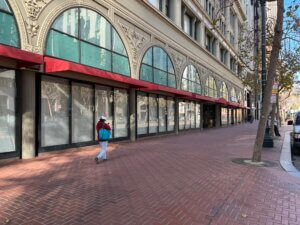
It is not just the number of homeless people, drug addicts and mentally ill that shocks. It is the number of vacant buildings. The ‘ghost office’ phenomenon, which has seen 27m sq ft of vacant office space dumped onto the market, is only part of the story. Whole blocks of long-deserted retail units lie empty, signs in dusty windows informing the few passers-by there are of another retail or hospitality leasing ‘opportunity’.
There are a lot of ‘opportunities’. The latest CBRE data puts retail availability on Union Square at 20.7%, rising to 21.5% Mid-Market and 25.8% on Showplace Square. The question is: is there worse to come – or is the only way now up for downtown San Francisco?
The whole of the West Coast was hit hard by the pandemic, but nowhere has the post-Covid recovery been slower than in San Francisco, thanks largely to the exodus during the pandemic of the tech community.
San Franciscans will be praying that Elon Musk’s decision to end Twitter’s work from home policy kickstarts the great return to the office. They will also be hoping it starts to rebalance the ratio of homeless to everyone else, which in the worst parts of the city, like one of the main shopping districts, Market, and the Tenderloin, where we are staying, is high.
In the once beating commercial heart of the city, you are confronted at every turn by the sight of the homeless, drug addicted and mentally ill. Office workers, shoppers and tourists are conspicuous by their absence.
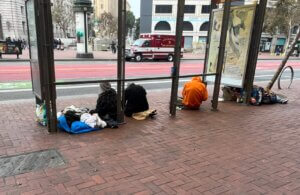
The few locals who prepared to brave the streets walk around the homeless or cross the street as if they are invisible. For visitors like us, they are anything but. We thought we had seen everything on the first day, but on our second day in the city, we are shocked to see a person lying passed out in a sleeping bag in the middle of a sidewalk outside a swanky hotel, their head turned sideways in a pool of vomit. Passers-by barely spare them a glance. A few blocks over, a shoeless woman in a wheelchair uses her feet to propel herself backwards down a sidewalk. People don’t register her.
These two are on the ‘right side’ of downtown. I soon find out why a friend advises us: ‘Don’t go left of your hotel.’ The sidewalk next to our hotel is no longer walkable thanks to a row of occupied tents, which we don’t notice at first, distracted as we are by the sight of a cannabis store on the corner and a young, smartly dressed woman talking to herself while agitatedly rattling a padlock on a boarded up building.
Locals blame the city government for paying people more than $600 a month to be homeless in San Francisco. The problem is only compounded by the fact everyone else seems to have left. The streets are near deserted at what would normally be peak times of the day, even at the weekend.
To generate footfall, you don’t just need workers, shoppers and tourists; you need shops, bars and restaurants. Their numbers have also been decimated, the exodus that started prior to 2020 only accelerated by the pandemic. Half the restaurants and bars we frequented on our previous trip have gone. The same is true of the retailers. Even discount retailers like TJ Maxx and Marshalls have gotten out of Dodge.
Just opposite the vacated Marshalls unit, people queue to enter the Ross Dress for Less, which is manned by loss prevention officers who let people in on a strict one in, one out basis. Their diligence is necessary. Shoplifting is rife. In two stores we enter – a Sephora and a CVS Pharmacy – people are openly trying to steal items.
The two would-be thieves in the Sephora are relieved of their items and allowed to go on their way. The CVS shoplifter just walks out with the stolen goods. Not for Californian shoplifters the indignity of being hauled aside by a security officer and potentially arrested. Under Proposition 47, stealing goods worth less than $950 in California is considered a misdemeanour rather than a felony, so shoplifters are simply handed a caution, free to go about their business.
No part of the main commercial drag is immune. While most of the stores are open in the Westfield, there are very few shoppers, and in some stores, there are none. At the Ferry Building, a quarter to a third of the shops and eateries are shuttered on a Thursday afternoon and there are just a few people milling around, although come Saturday, it looks more akin to its former buzzing self, thanks to the renowned weekly farmers market. Even on a Saturday, there are just a handful of people walking around the Salesforce Transit Center rooftop garden, which we overhear one man optimistically tell his companion is “a bit like the High Line” in New York. It isn’t.
We head to neighbouring city of Oakland in search of people. No joy. It is quieter still, several of the stores, bars and cafés on Jack London Square not open on a Monday. Oakland at least feels clean and safe. Not so downtown San Francisco. One local property professional, who asked not to be named, describes the situation there as “dire” and blames the perfect storm of the pandemic, poor city government and the exodus of the tech community during the pandemic.
An Uber driver, who took to cabbing after losing his job in hospitality during the pandemic, says he has “lost all positivity about the future” and informs us he and his wife will be leaving the city as soon as they can for the south of France. He adds that most of the tech start-ups, who were the lifeblood of the city, went under during the pandemic or left the city for greener pastures, never to return.
There are slivers of hope. Some neighbourhoods have almost bounced back to pre-pandemic volumes of traffic, notably Hayes Valley, Chinatown and nearby Little Italy. Aided and abetted by healthy student and residential populations as well tourists, their boutique stores, cafés and restaurants are bustling. Famous bookstore City Lights is still attracting plenty of visitors and tourist trap Fisherman’s Wharf is, if anything, busier than I recall last time.
Retail availability in the more resilient parts of town remains pretty low, running at sub-4% in areas such as the Mission and Chinatown. Whether the downtown heartland of Market or Union Square can bounce back remains to be seen.
CBRE data shows that there was a spike in asking rents for retail units last year because larger spaces with higher asking rates were being actively marketed. “That could be related to some optimism as re-openings were happening that has since dissipated,” according to the firm, noting that rents have fallen slightly this year and are now in line with those in the fourth quarter of 2020.
While leasing activity has also fallen since 2021, net absorption is positive for the first time since 2013, another cause for cautious optimism. CBRE also identifies the Marina, Pacific Heights and Russian Hill neighbourhoods as having seen an uptick in activity and rent growth.
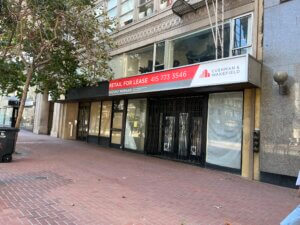
It estimates that anecdotally there is about 4.36m sq ft of retail space across 734 properties and that availability currently stands at around 4.1% (179,655 sq ft) with an average triple net rent of $47.37 (£40.34).
Alex Sagues, vice president of CBRE’s urban retail team in San Francisco sees green shoots of recovery. “Historically, downtown San Francisco and Union Square were fuelled by tourism and office workers,” he says. “The pandemic accelerated bifurcation in the downtown retail market. Now that travel and Covid restrictions have largely been lifted, full-service restaurants and high-quality fast casual or quick-serve restaurants have been doing very well.”
Echoing the observations made by Distrkt co-founders Camilla Topham and Michael Webb about the UK hospitality market, he adds that while there are fewer options than pre-pandemic, there has been an increase in demand for quality products and experiences, with some quality, quick-serve restaurants doing better than before the pandemic.
Sagues concedes that rising construction costs have been a barrier for retailers looking for space, but says opportunistic tenants are still willing to take second generation space because of its long-term value. “For example, luxury-adjacent brands are performing very well and continue to seek space on Union Square,” he says. “There have been a number of notable transactions, including YSL, Bottega Veneta, Chanel and others that have recently purchased or renewed or expanded their space in Union Square.”
That said, he acknowledges challenging times lie ahead, at least in the short term. “San Francisco’s downtown retail has a symbiotic relationship with downtown office and tourism,” he explains. “In the short term, macroeconomic factors, including inflation, stock market volatility, tech layoffs and the residual impact of the pandemic will be challenges for downtown retailers.”
However, there is reason to be more confident in the market’s medium- to long-term prospects, he argues, predicting that experience-driven operators such as full-service restaurants, luxury and luxury adjacent products will do well. “Landlords will also continue to partner with best-in-class operators, bringing some of the vibrancy back to downtown,” he adds. “The retail recovery will continue, but the rate at which the recovery occurs will be driven by these macroeconomic factors.”
Ongoing efforts to attract people back to the downtown area will help. The city has reportedly spent $26.3m this year on colourfully-clad ‘ambassadors’ from non-profit Urban Alchemy and Welcome Ambassadors to assist people in need, keep sidewalks clear of tents and drug users and help tourists and passers-by. On 25 October, the San Francisco Chronicle reported that a further $8.5m would be invested ahead of the holiday shopping season as mayor London Breed looks to increase the number of ambassadors in SoMa, the Mission and the Tenderloin.
Locals are not convinced the latest measures will be enough. They remember all too well the weekend before Thanksgiving last year, when hordes of thieves looted Union Square stores.
But although the outlook remains uncertain, it would not take much to tip things back in the city’s favour, especially if other employers follow the lead of Elon Musk and tech workers return. There is plenty to return to. As famous American architect, writer and educator Frank Lloyd Wright once said: “San Francisco is the only city I can think of that can survive all the things you people are doing to it and still look beautiful.”
He would probably take the same view today, because despite everything people continue to do to it, it still does.



The demise of the REITs