
It is a cold, grey and drizzly winter day in Milan. Most of the buildings surrounding the park at COIMA’s Porta Nuova redevelopment are not flattered by being shrouded in low-level cloud. Two, however, stand out from the crowd – and cloud. The twin apartment blocks that make up the iconic Bosco Verticale – or Vertical Forest – are not as verdant as in the height of summer but still look extraordinary – like the buildings that have reverted to the wild in video game turned HBO series The Last of Us – both from ground-level and their plant-bedecked balconies.
Italian ESG investor and developer COIMA raised the ESG bar when it enlisted renowned architect Stefano Boeri to design the multi award-winning towers, which were completed in 2014. Now, the company is poised to raise it again with the development of the Olympic Village for the 2026 Milan-Cortina Winter Olympics on another former railway sidings site, at Porta Romana.
BE News was delighted to be invited on a media trip to find out more about plans for the Olympic Village and take a look around Porta Nuova, the scheme that cemented COIMA’s reputation as an ESG-led regeneration specialist and put Milan on the map as one of the most desirable – and sustainable – cities to live in Europe. We also spoke to COIMA’s founder and chief executive Manfredi Catella to find out more about his sustainability ambitions and what the future holds for the company.
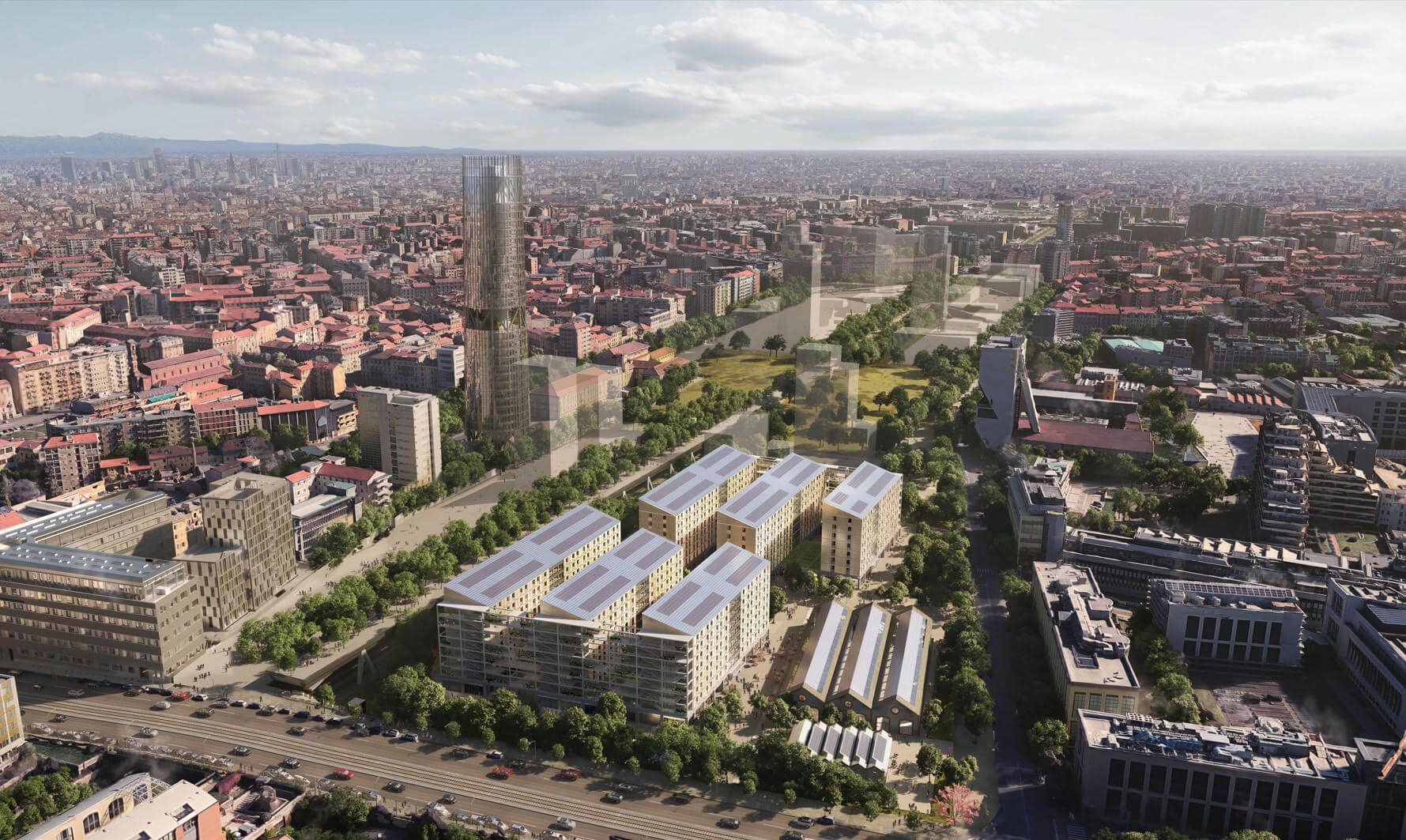
Walking around Porta Nuova and watching a presentation during which the plans for the Olympic Village were unveiled, you quickly realise that COIMA does not do anything by halves. Its two regeneration sites share two key attributes: they are both former railway sidings and vast in scale, Porta Romana covering some 190,000 sq m (2m sq ft) and Porta Nuova a whopping 346,500 sq m. While much of the vision for Porta Nuova has now been realised – it is now one of Italy’s most high-tech and international districts, boasting the country’s tallest skyscraper, the Unicredit Tower, and a GDP of €400bn – the vision for Porta Romana is still largely that, a vision.
However, this January marked a significant milestone for the project. The Porta Romana real estate investment fund, managed by COIMA SGR, announced it had secured a building permit for the 2026 Winter Olympic Village and signed the main construction contract, with Impresa CEV SpA, Grassi e Crespi Srl and Milani Impianti Srl, which will work in collaboration with co-developers COIMA and Covivio.
 The fund, which COIMA manages on behalf of investors Covivio, Prada Holding and the COIMA ESG City Impact fund, only completed the acquisition of the railway yard from Italian national railway company Ferrovie dello Stato Italiane in November, for €180m.
The total investment in the Porta Romana project is understood to be €1bn compared with a reported $2.5bn for the mixed-use Porta Nuova scheme. It is not just the scale of the two schemes that impress, but the scale of their ESG ambition.
The Bosco Verticale in Porta Nuova remains ground-breaking nine years on from its completion. Catella explains why. “The buildings that we developed together with the architect Stefano Boeri are the world’s first vertical forest concept and an icon of a new era of highly sustainable residential buildings,” he says. “Set within a new concept of public park and botanical garden, which plays host to a diverse programme of more than 200 cultural events and activities each year for residents, workers, and visitors alike, the Bosco Verticale and the surrounding pedestrian-led Porta Nuova neighbourhood provides a new approach to city living, one that is people-first and seamlessly fuses modern urban design and convenience with nature and a strong sense of community.”
It is little wonder that COIMA is trying to apply the principles and learnings from Porta Nuova at Porta Romana. Designed by US architects Skidmore Owings & Merrill (SOM), the Winter Olympic Village will accommodate 1,400 athletes and staff, have zero environmental impact and require minimal work to transform it into a mixed-use scheme boasting 1,700 student beds.
While COIMA is responsible for the development of the Olympic Village and its transformation into student accommodation, Covivio will oversee the development of the office space in the eastern quadrant of the site and Prada Holding SpA will build a laboratory. The development will be financed by Intesa Sanpaolo, which will support COIMA SGR, Covivio and Prada Holding SpA through a sustainability-linked loan.
The area will be managed through a community-focused digital platform scaled up from the neighbourhood app-based system developed by the HabiSmart acceleration programme for the Porta Nuova district.
There are other elements from Porta Nuova that will be familiar to Porta Romana visitors and residents, including a large central park, surrounded by residential, offices and social housing, and a Suspended Forest (rather than a Vertical Forest), an elevated greenway designed to contain rather than erase the old railway infrastructure.
The similarly strong environmental credentials don’t end there. The materials used have been specifically picked for their recyclability, reusability and environmental friendliness. All the buildings will be LEED certified and more than 30% of the energy will be generated via systems that use renewable sources, such as solar thermal and photovoltaic systems, reducing CO2 emissions by 40%. Moreover, around 50% of the site will be reserved for green spaces, designed by landscape architects Michel Desvigne and Elizabeth Diller, who designed the Highline in New York.
Other aspects of the scheme, however, will be unique, inevitably given the transition from an Olympics Village to a student accommodation-led scheme. SOM partner, Colin Koop, says: “We wanted to start the project with a really clear set of shared principles to make it both a compelling location for the athletes, while also honestly looking far beyond that initial period to try to find a way to ensure the project makes a true contribution to the Porta Romana district and the larger neighbourhood as well. We want this to be a vibrant mixed-use space.”
He adds: “It’s a very mineral, pedestrian-centric environment. We’ll have a series of fanatically organised retail experiences that will be attractive to the students but also to the community, so [we’ll be] converting and taking historic structures and turning them into a food hall, venues, coworking space, a gym and other elements. How it looks and feels is really critical.”
Construction on the Olympic Village started in earnest last month and the scheme is due to be delivered in July 2025.
Q&A with Manfredi Catella, chief executive and co-founder of COIMA
You say there are four factors driving product evolution: socio demographics, Covid, the energy crisis and technology. How have you adapted COIMA’s strategy to adapt to these challenges?
In recent years, we have experienced two major crises: the pandemic and the energy crisis, which are having a significant impact on our lives and needs and could irreversibly change real estate. For example, the pandemic has led to a change in working habits with the introduction of smart working, which will change office spaces and homes. Changes in lifestyle are leading to different kinds of requests, such as short-term rental residential products with associated services, while the focus of offices will be primarily about retaining and attracting talent.
Despite talks of a ‘flight to the country’ during the pandemic, cities will continue to grow, but they also represent the largest environmental polluter by CO2 consumption. The need to be more sustainable will change the way we live in cities, as 75% of younger consumers aim now to live in a sustainable way and are ready to change their lifestyles to reduce climate impact. This will drive change in real estate and represents an extraordinary opportunity for the industry to be more innovative in terms of sustainability and technology. At COIMA, we have consolidated our corporate organisation to face these changes head on and we are developing products that respond to the new needs of consumers. The real estate products in which we invest and which we create must be highly desirable and sustainable, but must also be beautiful and generate value.
How does your approach differ from other developers’ approaches?
There are certain key elements which differentiate COIMA from other developers: our integrated operating model and our capacity to work both at asset level and at a wider urban scale on projects with strong environmental and social characteristics. Our integrated model leverages our internal knowhow on both financial and technical expertise and ultimately means we can generate more value for all stakeholders.
In recent decades, Italy has steadily increased its share of renewable energy, but is still largely dependent on fossil fuels; and so is real estate. Over 90% of Italian national real estate has EPC ratings lower than C, so there is a huge challenge around decarbonising the built environment. We want to take the lead on that and are committed to developing to the highest levels of sustainability and are ensuring our developments are fossil-fuel free, running on electricity, not gas.
Sustainability is a real passion for COIMA – we live and breathe it – and it is not only an increasingly important driver of people’s decision making and priorities, but also of government regulation at national and EU level, which is driving innovative design and planning. We are working hard to be at the forefront of this more progressive and sustainable approach to development.
What KPIs are you setting as a business?
COIMA has set long-term ESG objectives. We have fully integrated the decarbonisation guidelines of the European Union, which is committed to being carbon neutral by 2050. Our projects are all subjected to ESG performance assessment through proprietary analytical metrics, which identify specific objectives and measurable ESG parameters. This enables us to verify the performance of each project against these objectives, providing additional transparency alongside independent verifications obtained through WELL, LEED and other ratings. Our Porta Nuova regeneration development recently became the first urban development in the world to achieve the LEED and WELL for Community ratings.
In 2022, our ESG City Impact Fund and the COIMA Opportunity II Fund achieved record scores of 99/100, putting them among the global sector leaders in Europe, while the Porta Nuova Garibaldi Fund’s score of 90/100 ranked it first among corporate core funds in Italy.
However, the pursuit of certifications and ratings must not simply lead to a superficial ‘box ticking’ approach to sustainability or social impact; they are not an end in themselves, but a means of reporting on efforts toward achieving the end. What is essential, first and foremost, is that real estate integrates ESG principles into its fundamental economic, social and environmental model, sets measurable objectives, and transparently reports against them.
It’s down to all of us to show leadership in the transition to the low carbon economy – passion and commitment to deliver positive social and environmental impact and transparency in reporting on performance is the best way to reach that destination.
You say: “It’s not just about getting money and investing money” and that you have to be careful about where you buy and what you buy.” Where and what are you looking to buy?
We do not limit ourselves by geography or asset class. We invest in Italy in all types of real estate, but the key aspect is to pay careful attention to changes in demand and create products that are of the highest quality, sustainable and resilient over time. We are alive to opportunities that can arise based on the asset class, and Italy offers many of them. For example, Class A offices in Italy are undersized compared to the demand, creating opportunities for new development, while many obsolete offices can be converted into residential. Furthermore, Italy now has large areas to be regenerated even within cities; in Milan alone, there are seven former railway yards that will be redeveloped in the coming years, including COIMA’s Porta Romana development, which will be home to the 2026 Olympic Village. That provides an unmatched opportunity for innovation in real estate that can put Italy at the forefront of sustainable development not only in Europe but the world.
You also say: “The stick of the game is in the hands of the big capital sources of the world.” How are they wielding that stick?
We are working with institutional investors who want to back projects with the highest environmental standards, which have a positive impact on the cities they are grafted into, generating value over a long period. For these investors, macroeconomic factors are not the only determining factor in the decision-making process. They certainly need to be monitored, but they do not determine evaluations, which are always linked to a long-term vision.
Unlike those who work in private equity, who have a short-term perspective, the stability of the legal framework is important for these investors, as is the ability to partner with public authorities. That is essential when you think of the kinds of project we commit to, like Porta Nuova, which have a timeline of at least 15-20 years. These investors also want the highest quality construction – construction is now about science and technology as much as it is industry – with full efficiency and environmental sustainability, and connections with public infrastructure.
Is the 15-minute city still valid as a concept?
The 15-minute city is a concept that can be partially applied to Italy, where cities are not large megalopolises, and are at a more human-scale with services already substantially distributed in all districts. Italy is a country with many medium-sized cities that represent great value due to their peculiarities: connectivity is an important issue not only within cities, but also at a national level, through physical and digital infrastructures that can connect them very quickly, consolidating a large network of cities that can put their respective resources into a system, mutually reinforcing each other.
In Milan, the municipality is creating a network of around 20 major regeneration projects, some of which are sited on disused railway yards, which are being masterplanned to be grafted into existing neighbourhoods, with connectivity within those districts, and between them, creating a network of interlinked cities within cities – giving rise to the 15-minute city vision.
You are now moving from the development phase at Porta Nuova to the operator phase. How will you engage with the local community as you make the transition?
The Porta Nuova redevelopment began in the 2000s but is not yet fully completed and will see further development in the coming years. Our role will continue over time as asset manager of the assets we have developed, but also as ‘district operator’ though the innovative public-private partnership between the Municipality of Milan, COIMA and the Riccardo Catella Foundation for the management of the public park BAM – Biblioteca degli Alberi Milano (literally the Library of Trees) – in the heart of the neighbourhood.
Since 2019, the foundation has been responsible for the management, safety, maintenance and cultural program of the park. BAM is actually much more than a park, it is a contemporary botanical garden in the heart of Porta Nuova that plays host to a diverse programme of more than 200 cultural events and activities each year for residents, workers, and visitors alike. We are working to create a park that engages the community, but we also want to create a sustainable business model that could be replicated in other parks in other cities across the globe.
We want to do keep doing more. We want to help create a more inclusive city by building relationships and generating benefits for neighbourhoods that have fewer opportunities. For this reason, we have activated a collaboration with an active association in the Quarto Oggiaro district, offering work opportunities to people in need. Over time, our goal is to involve all the companies based in Porta Nuova, creating a real exchange between the communities and a virtuous model for everyone.
Tell us more about the proptech accelerator programme HabiSmart?
COIMA is fully focused on transforming the real estate industry, starting from environmental and social sustainability, and putting people at the heart of process. Working with innovative start-ups to pursue this mission is an opportunity we cannot miss. There is a chance here to generate a tangible ompact. HabiSmart is a three-year programme with a total budget of €5.75m and is part of the CDP National Accelerators Network, which helps young companies specialising in high potential markets to grow. The startups are hosted in the COIMA HQ and can benefit from the district management technological platform implemented in the Porta Nuova district, which will act as a testbed allowing startups to test their prototypes, accelerating the process of development and scale-up, and get real-time feedback from the field.
The Porta Nuova technological platform, a pilot project for the digital transformation of the neighborhood, consists of an infrastructure of sensors and Internet of Things (IoT) devices capable of acquiring information in real time about the behaviour of users and their needs and the quality level of the infrastructures of the district. Thanks to the synergy with the Portanuova Milano neighborhood app, the platform allows users to interact with buildings and access an extended range of services, with the aim of activating a persistent community that is encouraged to collaborate in social impact in a simple and immediate way, and to pursue more environmentally conscious behaviours.
Porta Nuova doesn’t feature any affordable housing. What are you doing to address that nearby or in other schemes?
As part of the Porta Nuova development, affordable housing has been integrated into the neighbourhood near the famous Bosco Verticale. We are going to develop a much higher quantity as part of the Porta Romana and Valtellina urban regeneration plans. In particular, 1,700 apartments will be built in the Porta Romana railway yard project, 400 of which are subsidised housing. Certainly, housing affordability is a major issue in every major city and Milan is no exception. Given the high construction costs, it is extremely challenging to make affordable housing economically feasible. There is a real need for support from institutions and that could be provided in different forms; for example, a direct contribution of public funds, or to allow increased densities within urban areas, enabling additional buildings that could offset the costs of developing more affordable housing.
What is your ultimate vision for the Porta Romana district?
The Olympic Village comprises only around 15% of the total investment in the regeneration of the former Porta Romana railway yard. Our vision for Porta Romana is that the district will be integrated into the surrounding neighbourhoods, becoming a vibrant, green, sustainable and healthy place that is wholly part of the city, where work and leisure activities will be at the centre of neighbourhood life. The legacy for Milan will be enduring, with the Olympic Village becoming student accommodation post-Games, with 1,700 beds, addressing a major shortage of modern student accommodation in Milan.
Great attention has been paid to sustainability. The project will have zero environmental impact, as measured by the Nearly Zero Energy Building requirements. The materials used will be selected for their sustainability characteristics (recyclability, reuse, environmental friendliness); all the buildings will be LEED certified; [most of] the building structures will be permanent and the temporary ones will be reusable. More than 30% of the energy will be produced thanks to the installation of systems that exploit renewable sources, such as solar, thermal and photovoltaic systems. The greenery will cover 50% of the neighbourhood and the space will be characterised by the union of co-working, offices and public spaces. The project includes not only green spaces on the ground but also a suspended forest curated by the landscape designer of the New York Highline, Elizabeth Diller, which could become a new major tourist attraction in Milan.


Why Southwark was wrong to reject Berkeley’s 1,060-home scheme